At my moms birthday party, my sister mocked my fake illness in front of everyone!
My mother’s sixtieth birthday was meant to be an exercise in simplicity. On the phone, she had repeated the word like a mantra, a desperate plea for a drama-free evening. A small rented hall, a cake, and the people who shared her DNA. Simple. But nothing in my life had been simple for years, and as I drove toward the venue, I felt the familiar weight of the uniform pressing against my skin. Underneath my navy blazer, I wore my dress whites. They were a second skin, a suit of armor that felt simultaneously restrictive and necessary. I arrived early, as I always do, seeking the solace of an empty room before the cacophony of voices could turn the air into a claustrophobic fog.
I sat in my car for a full minute, my hands white-knuckled against the steering wheel. I focused on the rhythm of my breath—in, out, slow—trying to lower a heart rate that had been permanently set to a frantic tempo. My reflection in the rearview mirror was a stranger: jaw clenched, hair pulled into a severe bun, eyes reflecting a weariness that didn’t match my age. For many, a uniform is a symbol of pride, but for me, it felt like an exposure. It broadcast a version of myself that had died in a tangle of screaming metal and smoke, leaving behind a ghost that looked like a hero but felt like a wreck.
Inside the hall, the atmosphere was festive in a fragile way. Balloons drifted in the corners and soft oldies music skipped on a cheap sound system. When my mother saw me, her face lit up with a warmth that made my chest ache. She smelled of vanilla and nervous anticipation. She deserved an easy night, and I promised myself I wouldn’t be the one to break it. But that promise was a glass ornament, destined to shatter the moment my older sister, Brooke, walked through the door.
Brooke arrived with her usual performative flourish. She was the golden child, the one who stayed behind to build a “wellness brand” on social media while I was halfway across the world. She lived a life of daily affirmations and curated gratitude, an irony that always felt like a thumb pressed into an open wound. Her eyes flicked to my uniform, and a sharp, practiced smirk curled her lips. “Look who’s alive,” she announced to the room, her voice carrying over the music. “I wasn’t sure you’d make it with your… episodes.”
The room went quiet, that awkward, heavy silence where people laugh only because they don’t know how to protest. I felt the cold crawl of adrenaline in my stomach. “Happy birthday to Mom, Brooke,” I said, my voice steady. “Let’s not do this.” She laughed it off, wrapping her cruelty in the poisonous label of “teasing,” a word she used to sanitize every verbal barb she threw.
As the night progressed, I became an exhibit in a museum of my former self. Relatives I barely recognized asked when I was “going back” or if I was “better now.” I smiled and deflected, offering the neat, sanitized stories people prefer. They don’t want to hear about the nightmares, the nerve damage that makes my left hand go numb without warning, or the way the sound of a dropped spoon can send me back into the smoke. They want a hero’s journey, a clean recovery with a cinematic ending. They don’t want the messy reality of a person trying to navigate a world that feels too loud and too fast.
Dinner was a minefield. Every clink of a fork felt like a strike. When someone dropped a piece of silverware, I flinched so violently my chair nearly tipped. My uncle chuckled, calling me “jumpy,” unaware that in my mind, I was back in the belly of a falling bird. I almost made it through the evening. I almost kept my promise. But then Brooke stood up to give a toast, her wineglass raised like a weapon.
“I want to celebrate Mom for raising two strong daughters,” she began, basking in the applause. “One who stayed and helped, and one who vanished for years and came back with a suitcase full of invisible illnesses.” The silence that followed was deafening. Brooke tilted her head, her eyes gleaming with a mixture of resentment and performative pity. “I mean, how convenient. Too sick to keep a normal job, but healthy enough to wear the uniform when it gets you attention.”
Something snapped inside me—not with a bang, but with the quiet, final click of a lock. The years of being the family scapegoat, the years of Brooke using my service for her social media engagement while mocking my struggle in private, reached their limit. “Okay,” I said. The word was terrifyingly calm. “You want proof? You’re going to get it.”
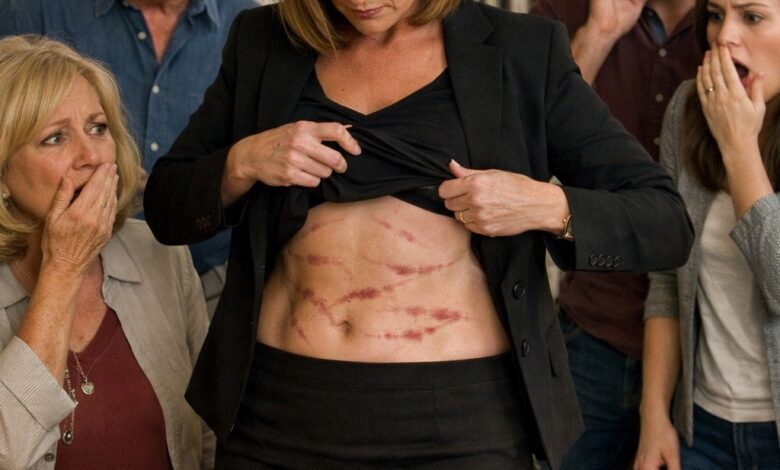
I stood up slowly, the eyes of every aunt, uncle, and cousin fixed on me. I unbuttoned my blazer and slid it off my shoulders. Then, I opened the first few buttons of my white shirt. Gasps rippled through the hall. I didn’t need to speak; the scars spoke for me. The raised, angry tissue across my collarbone, the jagged remnants of burns along my ribs, and the deep surgical furrow under my arm—they were a map of a day Brooke could never understand.
“You weren’t there when the helicopter went down,” I said, my voice cutting through the stunned silence. “But you were there afterward.”
Brooke’s smile had vanished, replaced by a pale, hollow mask. The room was so quiet I could hear the skipping of the music. For a moment, I saw the girl she used to be—the sister who used to braid my hair and promise to protect me. Somewhere along the line, her protection had morphed into a bitter competition. When I enlisted at nineteen, it wasn’t for the medals; it was to escape a life that felt too small and a house filled with a tension I couldn’t name. Brooke had branded me a hero online for the likes, but the moment I returned broken, I became an inconvenience to her narrative.
I had learned to run on blistered feet and cry silently in the dark. I had learned that the only way to survive was to follow orders and protect the team. But I had also learned that wounds don’t have to be visible to be fatal. Looking at Brooke, I realized she was the one with the invisible illness—a deep, festering resentment for a life she never left, projected onto the sister who had the scars to prove she did.
The helicopter mission was supposed to be routine. I remember the smell of the coffee, the weight of my gear, and the last text from my mother telling me to stay safe. I remember the moment the world turned upside down and the air became fire. Standing in that hall, exposed and trembling, I realized I didn’t need Brooke’s affirmations or her brand of wellness. I didn’t need the family to believe in my “episodes.” The uniform wasn’t the armor—the scars were. They were the proof that I had endured the unthinkable, and that I no longer had to remain silent in the face of a lie. I buttoned my shirt, picked up my blazer, and walked out of the hall, leaving the “simple” party and my sister’s silence behind me in the dark.