At 2 am my sister collapsed outside my home, bruised, shaking, holding her disabled daughter, Then came a text from mom, dont save that cripple
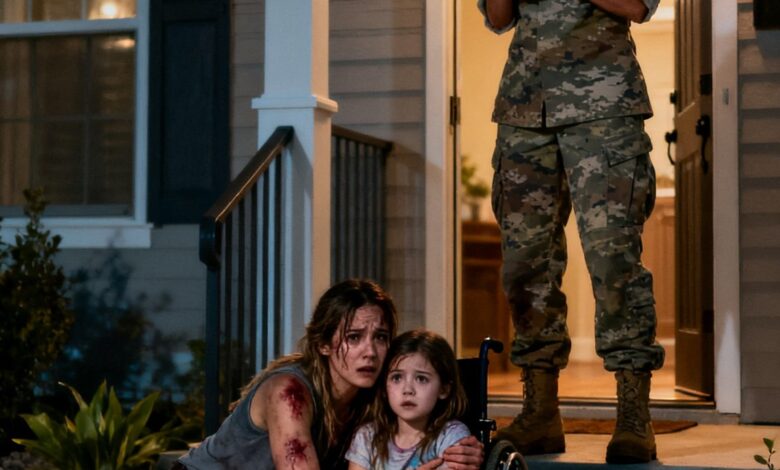
I was halfway through a lousy beer and an even worse crime-show rerun when someone started hammering on my door. Not a polite knock. Not a neighbor needing sugar. This was panic—fast, uneven, desperate. At 2 a.m., that kind of knocking is never good news.
I slid on my hoodie, covering the holster I’d left on the counter, and stepped toward the door. Before I reached it, I heard the voice.
“Maddie—please! Open up!”
Savannah. My sister. The one I hadn’t seen in months. The one Mom insisted was “too dramatic to deal with.”
I unlocked the deadbolt and cracked the door. She was barely standing, rain-soaked hair plastered to her face, one eye already swelling shut. Her little girl, Khloe—eight years old, wheelchair-bound, gripping the armrests so hard her hands trembled—was wedged against her side.
Savannah collapsed into me the second the door opened. I hauled her in, pulled Khloe’s chair over the threshold, and kicked the door closed behind us.
She was freezing, shaking, clothes torn. I’d seen enough domestic violence cases in the Military Police to know exactly what I was looking at.
My phone buzzed on the counter. I grabbed it without thinking.
A text from Mom: Don’t save her. She’s a traitor. And don’t bother with the cripple.
I stared at the message for one long, stunned breath, then set the phone facedown and turned back to Savannah.
“You’re okay now,” I said, easing her onto the couch and covering her with a blanket. She winced and clutched her ribs. The bruise underneath her shirt was already darkening—a bad one.
Khloe didn’t speak. She held a silver necklace to her chest like it was a lifeline.
“You hurt anywhere?” I asked her.
She shook her head but wouldn’t look up.
Savannah tried to speak. “Don’t… don’t call Mom.”
“I wouldn’t call Mom if she were the last human being on earth.” I grabbed my first-aid kit and knelt beside her. “Who did this?”
She closed her eyes and whispered, “Not now.”
Fine. But this wasn’t a “not now” situation anymore. I dialed 911.
By the time the paramedics arrived, Savannah was struggling to stay conscious. The police officer who came with them asked if I knew the suspect. I looked at Savannah. She shook her head again.
“Not yet,” I told the officer.
The paramedics lifted her onto a stretcher. I locked up and wheeled Khloe out beside them. Her chair squeaked over the concrete. She kept that necklace clamped in her fist.
Inside the ambulance, the paramedic strapped her mom down and checked vitals. Savannah’s eyes fluttered open.
“Don’t tell them everything,” she whispered.
Khloe finally spoke. “Grandma was there.”
Every muscle in my body went rigid.
“When?” I asked.
“Tonight,” she whispered. “She told me not to talk about Kyle.”
Kyle Merrick. Savannah’s husband. Mom’s golden boy. The guy who always smirked like he knew something you didn’t.
The paramedic looked at me. “That the suspect?”
Savannah shook her head weakly. “Please… not yet.”
At the ER, the bright lights exposed everything: the bruises, the swelling, the fear. The doctor listed the injuries—cracked ribs, a possible fractured arm, blunt-force trauma. I’d read those words in too many reports.
Mom’s text replayed in my head like a threat.
In the corner of the room, Khloe clutched the necklace again. I crouched beside her. “You’re safe here. Your mom is too.”
She hesitated, then whispered, “Grandma said she deserved it.”
The doctor left, and Savannah finally looked at me.
“It’s worse than you think,” she murmured.
“Then start talking.”
She swallowed hard. “Kyle takes Khloe’s disability money. All of it. Mom helps him. They say it’s for the household, but… they use it on trips, tools, junk we never see. When I asked to separate the account, he snapped. Said I was too stupid to handle anything.”
She blinked back tears. “Mom just sat there. Didn’t say a word. When I tried to leave with Khloe, she blocked the door.”
I pulled a Power of Attorney form from my bag. “Sign this. I’ll take it from here.”
She signed with a shaky hand. I opened my laptop, tracked the account routing number from her VA letters, and within minutes I had the records—hundreds of dollars siphoned out monthly. Vegas hotels. Golf clubs. A condo deposit. Nothing for Khloe.
I turned the screen to her. “He’s done.”
My phone buzzed again.
You stick your nose in, you’ll lose your stripes.
I didn’t need the name to know it was Kyle.
The next morning, I found him leaning on the doorframe of my apartment, grinning like he was the one holding all the cards.
“We should talk,” he said. “You’re making this messy.”
“You threatened a military officer,” I told him, lifting my phone so he could see the red recording dot. “Keep digging.”
The grin disappeared.
An hour later, I was in the base legal office with Deborah Langley—sharp, ruthless, exactly what we needed. When she heard everything, she didn’t blink.
“He’s toast,” she said. “Let’s go.”
Two days later, in court, Kyle tried to flip the script—filed for emergency custody, claimed Savannah was unstable, insisted she dragged a disabled child out of the house without cause.
Then Deborah laid out the truth—medical photos of the bruises, screenshots of the bank statements, the audio recording of Kyle threatening me, and the neighbor who’d seen Mom and Kyle pocketing Khloe’s disability money.
When the judge revoked Kyle’s visitation and handed full custody to Savannah, his entire face fell. Mom stared straight ahead in rigid denial.
Outside the courthouse, Savannah hugged Khloe, who was grinning ear to ear.
“Does this mean Grandma can’t yell at us anymore?” she asked me.
“Exactly what it means,” I told her.
A week later, Savannah sent me a photo of Khloe in the yard of their new place, arms raised in triumph as a neighbor’s dog licked her face.
She wrote: She says this is her safe spot.
That night, I visited them. No tension. No secrets. Just quiet, and hope, and a long road ahead.
When I got home, I opened a notebook and wrote one line on the first page:
Protect them. Always.
It wasn’t an order. Not a duty. Just the truth of who I was. And how far I’d go to keep them safe.