At 18, I Married a 60-Year-Old Farmer, What He Needed Seven Times a Day Wasnt What the Town Thought
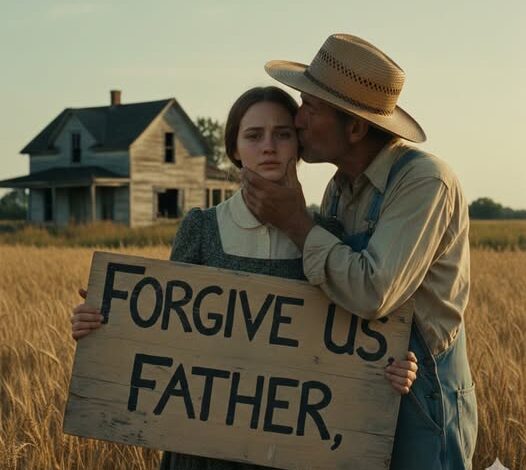
In the insular, wind-swept town of Millfield, Iowa, gossip is as much a staple as the corn harvest. When I married Walter Grayson on a humid Tuesday in 2025, the local tongues wagged with a fervor that bordered on the religious. I was eighteen years old, a girl whose life was a series of closed doors and folded dreams, still carrying the faint scent of library books and the cheap strawberry shampoo that was the only luxury I could afford. Walter was sixty—a widower with skin like cured leather and a back that bowed under the weight of four decades tending the Iowa silt.
The town saw a scandal; they saw a predatory exchange of youth for land, or desperation for a legacy. But the truth of our union was far more pedestrian and infinitely more tragic. I married Walter because, in a world that had become increasingly cold after the death of my mother and the indifference of a stepfather, Walter was the only person who looked at me and saw a person rather than a burden. He offered me a roof, and in exchange, I offered him my hands.
The rumors grew particularly sharp around the claim that Walter “needed me seven times a day.” The imagination of Millfield ran wild with that figure, painting a picture of a sordid, lopsided marriage. They were right about the frequency, but they were entirely wrong about the nature of the need. In the quiet, creaking reality of the Grayson farm, those seven moments were the pillars of a man’s survival—not just physically, but spiritually.
Our days began at 4:45 a.m., long before the sun had managed to burn the morning mist off the cornstalks. The first time Walter needed me was in the gray half-light of the bedroom. His arthritis was a cruel morning ritual, leaving his fingers as stiff as frozen taproot. I would sit on the edge of his bed and lace his heavy work boots, pulling the leather cords tight while he stared out the window, his jaw set against the pain.
The second time was at the breakfast table. Walter’s eyes were clouded with the early stages of cataracts, making the fine print of his leather-bound ledger look like a swarm of black ants. I would read aloud the previous year’s yields and the current market prices, my voice the only bridge between him and the business of the farm.
The third time occurred in the fields. As the tractor churned through the earth, Walter sat in the passenger seat while I gripped the wheel. He provided the direction, but I provided the vision. He was a man who knew every inch of his land by the feel of the vibrations beneath his feet, yet he needed me to see the obstacles he no longer could.
At lunch, the fourth need arrived: the management of his health. Two white pills for the heart, one blue for the blood pressure. Without my intervention, the bottles remained a blur on the counter, a silent threat to his continued existence.
The fifth time was mid-afternoon, when the Iowa sun was at its most unforgiving. Walter would retreat to the shade of the porch, and I would walk the perimeter fence. I checked for breaks, for downed wires, and for the encroaching rot of the wooden posts. I was his scout, his physical extension in a territory that was becoming too large for his slowing gait.
Dinner brought the sixth need: the need to listen. Walter was a vault of local history, of failed harvests and forgotten droughts. He spoke to keep the silence of the house at bay, and I listened to honor the life he had built.
But it was the seventh time that defined our marriage. Every night, as the clock ticked toward 9:17 p.m., a chilling transformation would overcome him. We would sit on the porch, the creak of the swing the only sound in the vast, darkening landscape. Walter would go rigid, his eyes fixed on the long dirt road that led to the highway. This wasn’t the longing of a man waiting for a guest; it was the paralyzed fear of a man waiting for a ghost.
For months, the secret of 9:17 p.m. hung over the farm like a storm that refused to break. I eventually learned that this was the precise moment the security cameras had captured a set of unidentified headlights on the night his son, Evan, vanished three years prior. Evan had been twenty-two, a boy who looked at the horizon and saw a cage instead of a home. The official story was that he had run away, chasing the neon lights of a city that didn’t know his name. But Walter knew better. He knew his son wouldn’t have left the keys in the ignition of a truck abandoned at Miller’s Creek.
The true secret of our marriage wasn’t a physical one; it was a pact of vigilance. Walter hadn’t married me for a wife; he had married me for a witness. He needed someone whose eyes weren’t clouded by the past to see the danger that was still lurking in the present.
The breakthrough came when I discovered a hidden metal tin in the barn loft, buried beneath a layer of dust and discarded baseball trophies. Inside was a USB drive—a modern anomaly in Walter’s analog world. When we finally accessed the files at the local library, the “chilling secret” the town suspected was replaced by a corporate nightmare. Evan hadn’t been a runaway; he had been a whistle-blower. He had uncovered a scheme by a regional agricultural conglomerate to intimidate small-hold farmers into selling their land for pennies on the dollar—a “land grab” fueled by systemic coercion.
The headlights we saw at 9:17 p.m. weren’t ghosts. They were the slow-moving vehicles of the men who had silenced Evan, coming back to check if the old man was finally ready to break. The USB contained Evan’s draft of a confession, revealing how he had initially been recruited to help “convince” his father to sell, only to realize too late that the company intended to use force. He had been murdered not for what he did, but for what he refused to finish.
With the evidence I found, the state authorities finally moved in. The arrests that followed stripped the veneer of respectability from the corporation and brought a grim closure to the mystery of Miller’s Creek. Evan’s remains were recovered, and the “disappearance” was reclassified as a homicide.
In the year that followed, the farm changed. It didn’t become easier—farming in Iowa never is—but the heaviness lifted. Walter stopped watching the road at 9:17 p.m. He began to watch the stars instead. When he passed away quietly in the spring of 2026, he left the farm to me. The town stopped whispering. They realized that an eighteen-year-old girl hadn’t married a sixty-year-old man for a paycheck. She had married him to be his strength when his own failed, and he had married her to ensure that the truth would outlive him.
Statistically, “May-December” marriages like ours account for less than 1% of unions in the rural Midwest, and they are often met with the same social skepticism we faced. However, research into caregiver marriages suggests that these partnerships often provide a vital social safety net in aging agricultural communities where traditional family structures have been fractured by out-migration. In our case, the partnership saved a legacy. I didn’t just inherit acres of corn; I inherited the justice that Walter had been too broken to seek on his own. Seven times a day, he needed my help to live, but it was the eighth time—the time I spent searching for the truth—that finally set him free.