At 16, I Was Thrown Out, Then I Inherited a Cave That Changed My Life!
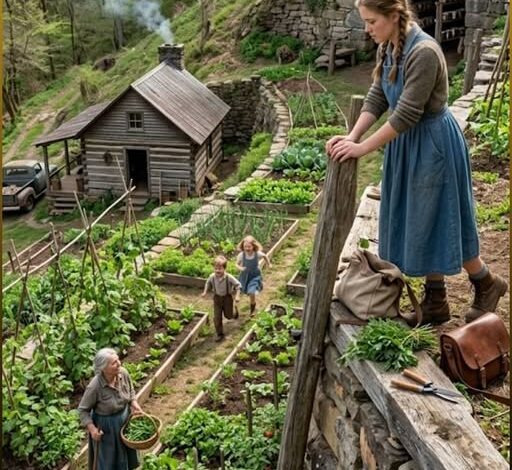
Evelyn Bell Hart had never expected inheritance to arrive in the form of a cave. At sixteen, thrown out from the convent school that had been both her home and prison, she found herself on the edge of the Appalachian mountains, with nothing but a bag of ill-fitting clothes and a sense of uncertainty pressing against every thought. She thought of herself as invisible, a girl abandoned to the wind, destined to scrape by unnoticed.
Then Mr. Pike appeared, a messenger of her grandmother’s carefully arranged world. “Your grandmother was an unusual woman,” he said. Evelyn blinked, unsure whether that meant difficult or merely private. “In these parts, it mostly means private,” he explained. He handed her the key, deed papers, and five dollars folded twice. “That’s from me,” he added. “Not from the estate.”
Evelyn walked the rugged path toward the cabin that had once belonged to Nora Bell Hart, her grandmother, a woman who had lived alone for nearly forty years. She had been known for her quiet labor, her refusal to be beholden to anyone, her meticulous habits and secretive ways. The cabin itself had a stooped dignity, with a sagging porch, a cracked window, and a door that resisted opening, as if it hadn’t expected visitors for decades.
Inside, the modest furnishings reflected survival and methodical care rather than luxury: a neatly made bed, a scrubbed table, shelves of jars, dried herbs hanging from rafters, and a cast-iron stove. Books filled the shelves, not novels or sermons, but texts on botany, soil, fungi, weather patterns, seed saving, and medicinal plants. Hand-drawn diagrams and meticulous notes lined the walls, creating the impression of a scientist’s workshop hidden in the mountains.
On the table lay a journal, its last entry a thin, deliberate line of handwriting: “If Evelyn comes, tell her not to be frightened by the vines. The entrance is behind them. Everything is behind them.” No greeting, no apology, no explanation. Just instruction. And yet, it felt like a hand reaching across time, guiding her.
Evelyn spent the first day tending to the cabin—sweeping, patching, and making it habitable. She discovered provisions, drew water from the spring, and slept under cedar-scented quilts. The following morning, she began searching for the cave, pushing through rhododendron, grapevines, briars, and thick ivy. She stumbled through false leads and animal burrows, frustration building as each potential opening proved false.
On the third day, near a dense wall of vines, she felt a cool ribbon of air on her face. This was different from the wind. It carried the scent of damp stone and subterranean earth. Taking a hand sickle she found in the cabin, she began to clear the overgrowth. Hours passed in blistering labor, sweat soaking her dress despite the chill. She wrestled with thick, thorny vines that had grown unchecked for decades. At times, she thought, let it stay buried, yet resolve kept her moving forward.
Finally, limestone appeared beneath the last layer of vines. Carved letters confirmed her suspicion: N. B. HART, 1914. Her grandmother had marked the cave, claiming it, hiding it, preserving it. Evelyn lit a kerosene lantern and entered. The tunnel initially narrowed, cool and damp, but gradually widened, revealing a chamber so vast the lantern seemed minuscule within it.
Inside, rows upon rows of mushrooms thrived in organized abundance. They grew from oak logs, dark medium-filled sacks, and wooden trays arranged to optimize the cave’s natural humidity. Pale oysters, shaggy lion’s mane, bronze-capped shiitake, coral-like clusters—hundreds, perhaps thousands, of mushrooms flourished. This was no hobby; it was an underground farm, a living architecture designed for survival and study.
Over the next weeks, Evelyn learned to maintain the cave. She mastered which logs were spent, how to mist without oversaturating, how to manage airflow, and which mushrooms were safe to eat. Her diet was simple: beans, cornmeal, wild greens, and the first mushrooms she dared cook. Every bite, rich and earthy, reminded her that survival required both courage and skill.
By May, she had established a rhythm. That’s when Ida Collins appeared—a sharp-eyed widow who had once known her grandmother. Ida tested Evelyn’s knowledge and skill, teaching her the subtleties of survival: how to repair shingles before a storm, detect foul water, store potatoes, and prevent rodents from consuming seed jars. Evelyn, in turn, taught Ida about mushrooms. Their partnership grew into friendship, each lesson cementing the legacy her grandmother had left behind.
By summer, Evelyn’s mushroom harvest exceeded her personal needs. Hunger was real in the county; men were at war, wages uncertain, fresh food scarce. Evelyn sold her produce at the general store. Initially, townspeople mocked her. “Cave mushrooms? Sounds like disease,” one said. But her calm demeanor, her visible knowledge, and the undeniable quality of her food won them over. Week by week, more neighbors came to buy, until her cave farm became a vital part of the community’s sustenance.
That winter, Evelyn discovered a second chamber, a dry stone-lined room behind the main cave. It contained hundreds of jars of seeds: corn, beans, squash, tomatoes, herbs, and flowers, each labeled with careful notes and dates. Some names were practical, others poetic: Bloody Butcher Corn, Cherokee Purple, Turkey Craw Bean, Candy Roaster. Her grandmother’s journals explained her careful curation of seeds to preserve regional varieties, Indigenous knowledge, and heirloom lines threatened by commercial agriculture. The lesson was clear: “A seed is only a story if someone plants it.”
Evelyn began planting terraces above the cabin, reconstructing retaining walls, and cultivating the heirloom varieties. The garden thrived in waves of corn, squash, tomatoes, pole beans, and herbs, pollinated by bees drawn to the flowers she carefully tended. Visitors began to recognize the value of her work. Scholars, farmers, and researchers arrived, awed by the precision and knowledge preserved in her grandmother’s cave.
In 1944, Daniel Reed, a returned veteran studying agriculture through the GI Bill, came to the hollow. He did not pity her, nor did he perform gallantry; he quietly assisted, helping repair terraces and drainage channels. Their courtship unfolded gradually, built on work, respect, and shared dedication. By autumn, love had grown not from rescue but from partnership, standing side by side in the shadow of her grandmother’s work.
Evelyn and Daniel married, and over the years, they expanded the cave’s operations. They sold mushrooms to local towns, preserved seed varieties, and educated the community. Evelyn’s meticulous care transformed the once-dismissed cave into a thriving center of preservation and learning. Children grew up surrounded by life, soil, and knowledge, playing in the gardens and learning the legacy of heirloom seeds.
By 1986, Evelyn passed peacefully within the cave, surrounded by the life she had nurtured. Her daughter found her, seated against the limestone wall, serene. Above the entrance, Nora Bell Hart’s inscription remained, with a new line added for Evelyn: EVELYN HART REED – SHE CLEARED THE WAY. Not just inheriting a miracle, but cultivating it, preserving the past, and shaping a future where what others overlooked became invaluable.
The cave became the Whitfield-Hart Heritage Seed Conservancy, a hub of knowledge, preservation, and community. Festivals, seed exchanges, and educational programs ensured that Nora and Evelyn’s vision endured. Evelyn’s story, once ridiculed, became a testament to endurance, vision, and the power of labor, patience, and persistence to transform neglect into legacy .