An Ex-SEAL Sniper Bought a Remote Mountain, Poachers Crossed Her Fence and Vanished Overnight
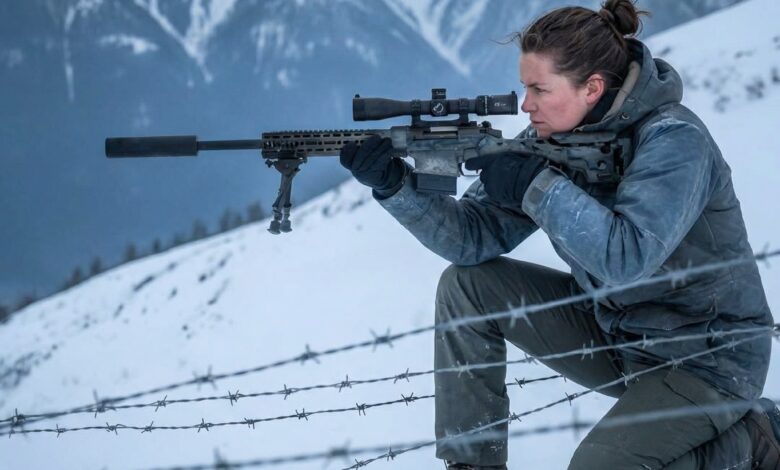
The northern Rockies do not offer forgiveness to the unprepared; they simply offer silence. This was the first truth Mara Holt embraced when she purchased eight hundred acres of timber, jagged rock, and unforgiving elevation. To the local land registry, she was merely a private citizen seeking solitude. To the classified archives of the U.S. Navy, she was a former elite sniper—medically retired, honorably discharged, and profoundly finished with the politics of war.
Mara didn’t move to the mountains to build a sanctuary; she moved to build a fortress of the mind. Her perimeter was a masterclass in defensive layering: steel-reinforced fencing along the primary ridgelines, motion sensors buried beneath the frost line, and thermal cameras that monitored the silent valleys where sound could travel for miles. Everything was legal, meticulously maintained, and perfectly quiet. For Mara, the “peace” she sought wasn’t the absence of conflict, but the total control of her environment.
That control was tested on a frigid Christmas Eve. At 22:47, while the rest of the world settled into holiday traditions, a single silent alert chirped in Mara’s cabin. Standing barefoot on her concrete floors, she watched the wall monitor as three heat signatures moved along her eastern boundary. These were not the erratic movements of lost hikers or the heavy gait of local hunters. They moved with a deliberate, low-slung tactical rhythm. They were mapping her defenses.
Mara didn’t reach for a phone to call a distant, understaffed sheriff’s office. She reached for her boots. In the biting cold, she moved uphill with the ghostly patience of someone who had spent years becoming part of the landscape. She intercepted them just as one man applied a specialized cutter to her fence. The wire didn’t snap; it yielded under professional pressure. In that moment, the old clarity of the hunt woke up within her.
Using a handheld speaker mounted to a nearby tree, she issued a calm, disembodied warning: “You’re trespassing on private land. Turn around.” The men froze, then chuckled, dismissing the voice as a remote deterrent. One raised a rifle, a slight, aggressive shift in posture. It was the only invitation Mara needed.
She didn’t fire a shot. She didn’t have to. Mara knew the topography of her mountain like the map of her own soul. As the men advanced, the first stumbled into a natural, ice-slicked depression she had left intentionally unmapped. He slid twenty feet into a deadfall, his weapon clattering into the darkness. When the second man raised his rifle to find the source of the noise, Mara emerged from the shadows behind him. With the surgical precision of her former life, she neutralized his weapon and his balance in one fluid motion. The third man, witnessing his team dissolve into the shadows, turned and fled into the blinding white of the snowline.
Mara didn’t pursue him. Fear and the freezing terrain would do the work for her. She zip-tied the remaining two, dragged them to the legal boundary of her property, and left them with a satellite phone and a message for their employers: “This land isn’t for sale.” By dawn, they were gone, leaving behind only the ghost of their intrusion.
Two weeks later, the incursions evolved. Drones—commercial models modified for surveillance—began buzzing the ridges. Mara downed the first with a signal jammer and watched the second fall to a “dead zone” of her own creation. It became clear that she wasn’t just fighting poachers; she was resisting a sophisticated interest. An old teammate, Evan Brooks, confirmed her suspicions via a burner line. Black-market wildlife traffickers and private contractors were eyeing her mountain as a vital, unmonitored transit corridor for illegal trade. To them, she was a logistical hurdle. To her, they were an affront to the only peace she had left.
The second major attempt involved six men, coordinated and heavily armed. Mara watched their thermal signatures split into teams, a classic pincer movement. She waited until they reached the clearing near her cabin before flooding the woods with high-intensity lights and disorienting acoustic frequencies. In the chaos of the blinding flashes and the echoing snow, the “pros” became amateurs. They tripped over hidden deadfalls and collided in the dark. Within minutes, the mountain had spat them out.
By late spring, the mountain achieved a new kind of equilibrium. The “vanishing” of the poachers became local legend, but the reality was simpler: the risk had finally outweighed the reward. The predators had learned the boundary. In the wake of the conflict, a federal convoy arrived—not to arrest her, but to negotiate. Land management agents had been tracking the very trafficking corridor Mara had inadvertently plugged. Recognizing her as a strategic asset, they proposed a permanent conservation easement. It offered federal protection and restricted access, ensuring that no roads, tourists, or developers would ever touch the timber and rock she called home. Mara signed the deed, realizing she didn’t own the mountain; she had merely earned the right to belong to it.
Evan Brooks visited one last time in July. He noted that while her military record was buried, her reputation as the “Ghost of the Mountain” was growing. He pointed out that she hadn’t broken the intruders’ bones so much as their confidence. “That’s harder to fix,” she agreed.
The final test came from a single, unarmed man who crossed her boundary late one night. He didn’t come to hunt or to steal. He was a veteran of one of the previous failed teams, a man who had walked away from the life after that night. He stood ten feet from her gate and asked how she had done it—how one woman had made a professional team vanish into the snow.
Mara looked at him, her eyes as cold and clear as the mountain air. “I didn’t do anything,” she told him. “You chose to come here thinking no one would stop you. You were wrong. That was the lesson.”
She opened the gate and let him walk away, a final witness to the line she had drawn. As summer deepened, Mara began to hike without her rifle. She planted trees in the scars left by the drones and the boots. She sat by the stream in the evenings, no longer expecting an alarm. The fence remained, and the cameras still watched, but they gathered the dust of a quiet world.
Real power, Mara realized, wasn’t about the ability to destroy. It was about the ability to be understood without saying a word. The legend of the vanishing poachers would persist in the towns below, ensuring that the remote eight hundred acres remained a blank spot on the map. Mara Holt had finally found her peace, not through flags or funerals, but through the enduring silence of a mountain that had finally accepted her terms. The line stayed drawn, and for the first time in her life, the world listened.