A German Shepherd Was Left to Freeze in a Steel Cage, A Navy SEAL Saved the Entire Forest
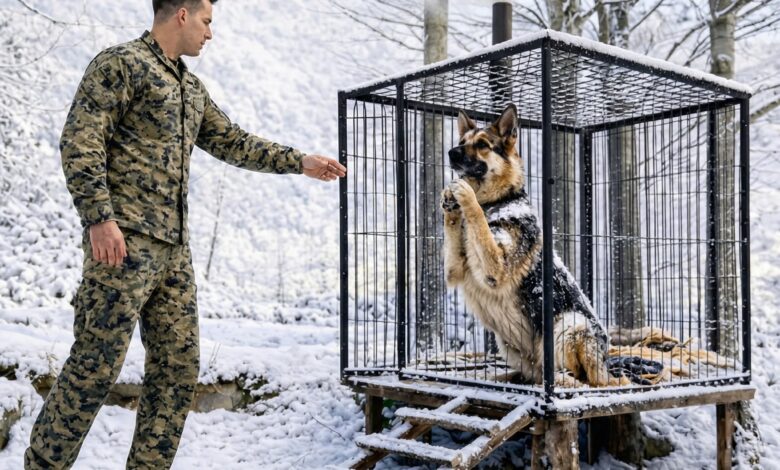
The mountains of the North Ridge do not offer second chances; they only offer a cold, indifferent silence. When the temperature plummeted below ten degrees and the dawn was still nothing more than a bruised shadow against the peaks, Ethan Cole received a call from Sheriff Daniel Reeves. There was no panic in the Sheriff’s voice, only a grim, professional restraint that Ethan—a man whose past as a Navy SEAL was written in the scars he carried and the solitude he sought—recognized instantly. There was something on the ridge that didn’t belong.
Ethan reached the summit on snowshoes, his breath hitching in the biting wind that whipped sideways through the ancient pines. Fifty yards off the beaten trail, he found the anomaly: a steel cage, bolted to a skeletal, dead pine tree and half-buried in a drift of crystalline snow. The metal was thick with ice, and the lack of human tracks suggested that whoever had brought it there had no intention of returning. Inside, huddled in a ball of shivering fur, lay a German Shepherd. The dog didn’t bark or snarl; he simply lifted his head with a slow, agonizing effort, his eyes alert despite the frost clinging to his lashes. His breathing was shallow, his frame dangerously skeletal, and one paw shook with the rhythmic tremors of advanced hypothermia.
Crouching low, Ethan spoke in the calm, low-register tone of a man used to high-stress extractions. The dog’s ears twitched. The cage door had been wired shut with a deliberate, malicious permanence. Ethan sliced through the bindings with his knife, shed his own heavy coat to wrap the freezing animal, and lifted him out. The Shepherd went limp, surrendering to the warmth. As Ethan carried him back toward the cabin, he noticed a thick, circular scar around the dog’s neck—the telltale mark of a lifetime spent on a short, heavy tether.
Back at the cabin, the roar of the woodstove signaled the beginning of a long night. Ethan summoned Dr. Lena Hart, the region’s only veterinarian, who arrived to find a grim scene. Beyond the malnutrition and dehydration, she pointed out the remnants of a professional K-9 harness tangled in the fur, complete with faded serial stitching. This wasn’t a case of a pet owner who had grown overwhelmed; this was the disposal of a professional asset. Someone had trained this dog, used him, and then decided to erase him in the most literal sense possible.
As the dog, whom Ethan named Ranger, began to stabilize, a chilling pattern emerged. Ranger didn’t fear the wild; he feared the sounds of industry. The grind of a diesel engine, the clinking of heavy chains, and the acrid scent of gasoline fumes sent him into a state of rigid, hyper-vigilant terror. Ethan had seen this kind of conditioning before in conflict zones—dogs used for detection or intimidation, broken by the very men they were trained to protect.
On the third morning, Ranger led Ethan deep into the timber, far beyond the usual hiking trails. With the precision of a scout, the dog located a series of illegal snares concealed beneath the snow, followed by a massive, illicit logging operation. They found stacks of timber camouflaged under heavy tarps and caches of fuel hidden in the brush. This wasn’t local poaching; it was a sophisticated, industrial-scale extraction pipeline operating in the heart of protected federal land.
The exposure of the operation brought the “owners” out of the woodwork. Three men, led by a man named Caleb Turner whose smile was as sharp and cold as a razor, arrived at Ethan’s cabin claiming the dog was theirs. They offered flimsy papers and thinly veiled threats, but Ranger made the choice for them. He stood between Ethan and the intruders, his hackles raised and his eyes locked on Turner with a silent, murderous intensity. Ethan didn’t need to see the men’s reaction to know that Ranger was the only witness to a crime they couldn’t afford to let go public.
The conflict escalated quickly. After a community meeting where the town was split between the desperate need for logging jobs and the preservation of the law, someone attempted to run Ethan and Ranger off a mountain road. They survived by plunging into the dense tree line, the roar of the truck fading into the snowy abyss. It was clear then: this was no longer about a dog. It was about a conspiracy that believed winter and isolation would hide its tracks forever.
The final reckoning came under the cover of a moonless night. Sheriff Reeves, supported by State Wildlife and federal agents, moved on the Northpine Resource Group—the shell company behind the devastation. Ethan and Ranger acted as the vanguard, navigating the tactical units through the narrow timber where technology failed. Ranger moved like a shadow, pausing to alert the team to tripwires hidden beneath the snow crust. When the raid began, one of the primary suspects attempted to flee through a ravine. He didn’t get far. Ranger broke into a sprint, cutting the man off with a singular, commanding bark that echoed like a gunshot.
By dawn, the operation was dismantled. Seven men were in custody, and the evidence recovered linked the illegal logging to a multi-county trafficking ring. The steel cage was recovered as evidence—a silent, rusted monument to the cruelty that had sparked the investigation. Ranger watched from the ridge as the flatbed truck hauled the cage away, his posture finally relaxing as the metal disappeared from his sight.
The aftermath was a complex mix of local anger and collective relief. While some lamented the loss of the “off-the-books” income, the majority of the community was shaken by the sheer brutality of the cage. A new group emerged, The Ridge Guard, composed of locals who vowed to monitor the forest they had previously taken for granted. Ethan took on the role of training them, and Ranger became the silent mascot of their vigilance.
Healing, as Ethan knew, wasn’t a loud process. It was the slow fading of nightmares and the gradual trust in a warm hand. By spring, Ranger no longer flinched at the sound of a starting engine. He remained with Ethan, not out of a lack of options, but out of a shared understanding. On long patrols through the recovering forest, Ranger would often sit at the exact spots where the snares had been hidden, marking the memory of the ground he had helped reclaim.
One evening, nearly a year after that first dawn call, Ethan sat on his porch with Ranger resting his head on his boot. The forest seemed to breathe with a new, lighter rhythm. Ethan realized that a single decision—the choice not to look away from a cage in the snow—had unraveled an empire of greed. The forest remembered the scars of the chains and the fuel, but it also remembered the man and the dog who had refused to let it freeze. Ranger closed his eyes, his breathing steady and deep, finally safe in the woods that had once been his graveyard.