A doctor said, Sir, your wife is critical, He did not even look up!
The institutional scent of industrial bleach and the sharp, metallic tang of blood clung to the hospital hallway where my life was systematically dismantled. Behind the heavy double doors of the surgical unit, I lay in a drug-induced oblivion, my body stitched together after an emergency C-section that had successfully salvaged three premature lives while nearly extinguishing my own. While machines hummed and red monitors blinked in the twilight of the intensive care unit, the man I had loved for a decade was busy with a different kind of surgery.
Grant Holloway stood in the corridor, adjusting the cuffs of his bespoke Italian suit with the practiced composure of a man closing a mid-market merger. He took a pen from his lawyer and signed the divorce papers without a tremor of hesitation. Only ten minutes prior, my heart had flatlined. Grant hadn’t asked if the infants were breathing or if the woman who had shared his bed for ten years would ever wake up. He only asked how quickly the filing could be finalized. When a weary surgeon emerged to inform him that I was in critical condition, Grant didn’t even look up from his leather folder. He simply informed the doctor that he was no longer my husband and suggested they “update the file.”
By the time I regained consciousness, I was a ghost in my own life. I woke to a hollow ache in my abdomen and the terrifying realization that I was legally untethered. A bureaucratic administrator, cold and efficient, informed me that my marital status had changed while I was under anesthesia. Grant had triggered pre-signed contingencies, effectively erasing me. I was uninsured, stripped of my marital assets, and moved to a windowless room on a different floor where the blankets were thin and the cardiac monitors were absent. I was no longer Marilyn Holloway, the socialite wife of a Manhattan mogul; I was a liability to be managed by the billing department.
Across the city, Grant stood in his Park Avenue penthouse, staring at the skyline with the smug satisfaction of a man who had successfully offloaded a failing asset. To Grant, our triplets weren’t a miracle; they were an anchor that threatened his professional ascent. He needed to be lean, decisive, and unencumbered for his company’s upcoming funding round. He ignored the messages about the infants’ fragile health, focusing instead on his future with Bel Knox, a woman who didn’t come with the “domestic chaos” of medically fragile children. He believed he had won, having cut the ties so cleanly that no blood would stain his tailored suits.
However, the cruelty of Grant’s exit had been too surgical for its own good. As I lay in my sterile, beige room, struggling to breathe and mourning children I could only see through a glass partition, a counter-offensive was quietly forming. Dr. Naomi Reed, the head of the NICU, had seen enough of Grant’s “policy” to recognize it for what it truly was. When the hospital administration pressured her to downgrade the triplets’ care due to a lapse in insurance, Naomi didn’t blink. Instead, she reached into her private network, contacting a man who specialized in the kind of justice that doesn’t show up on a hospital bill.
That night, a man named Ethan Cole entered my room. He didn’t wear a white coat or a badge; he wore the quiet authority of a man who lived in the high-stakes world of trust law. He explained that my grandmother, Eleanor Parker Hale, had established a fortified investment trust decades ago—a fortune so vast and private that it had been the subject of secret litigation for years. The trust had been frozen, waiting for a specific activation clause: the birth of multiple legitimate heirs. My triplets weren’t an anchor; they were the keys to a kingdom.
The irony was as sharp as a scalpel. By divorcing me moments after the birth, Grant had inadvertently severed his own connection to one of the most powerful capital influences on Wall Street. He had discarded me to impress investors, unaware that the very capital he sought was controlled by the woman he had just labeled “uninsured.”
As I regained my strength, fueled by a primal need to protect my children, the legal machinery Ethan Cole set in motion began to grind Grant’s world to a halt. It started with a “pause for review” from the Parker Hale Trust. Grant’s secondary partners began to pull back, citing concerns over his personal risk exposure and the ethical implications of his recent “restructuring.” The investors who had lauded his decisiveness began to see a man whose lack of character made him a volatile gamble.
The system that Grant had used to crush me—the paperwork, the fine print, the cold dismissal of human life—was now being used to dismantle him. Every insurance cancellation he had signed was documented as evidence of bad faith. Every attempt to leverage the medical care of his own children became a permanent stain on his professional reputation. While I moved my babies to a private facility funded by the resurrected Parker trust, Grant found himself in an increasingly lonely boardroom. The “distractions” he had tried to eliminate had become the very obstacles that would block his funding round.
The final blow came not in a hospital hallway, but in a courtroom. As the Parker Hale Trust asserted its influence, Grant’s company was forced into a transparency audit that revealed a series of financial shortcuts he had taken to maintain his high-flying lifestyle. The “strong” man was exposed as a hollow one. He had traded his family for a thin smile in a Manhattan mirror, only to find that the mirror was cracked.
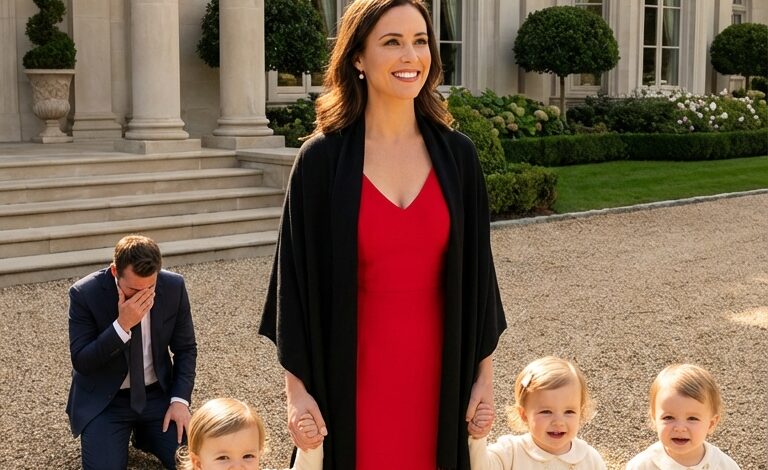
I sat in my new home, a sun-drenched space far from the sterile bleach of the ICU, holding my children as they finally grew strong enough to breathe without machines. I was no longer the discarded woman in the windowless room. I was the steward of a legacy that Grant would never touch. I realized then that the most dangerous mistake a man like Grant could make wasn’t leaving his wife; it was assuming that the person he left behind had no value. He had signed the papers to erase me, but in doing so, he had written the final chapter of his own downfall. I looked down at my three survivors, their tiny heartbeats steady and rhythmic, and knew that the hollow silence of that hospital hallway had been replaced by a future he could never afford. Grant Holloway had wanted a life without anchors, and now, he was adrift in a sea of his own making, while I finally had everything worth holding onto.