A Christmas Miracle! How a Cowboy Answered the Wish of Young Girls to Find a Family
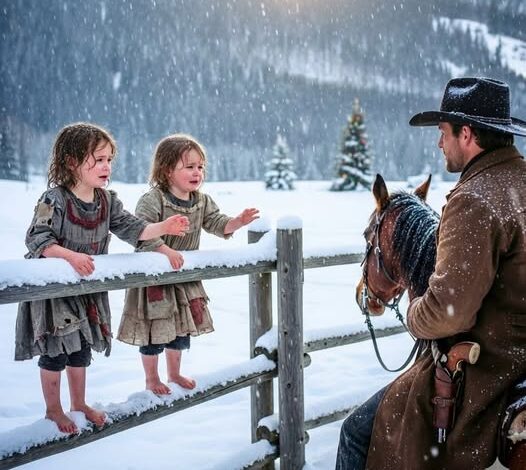
The first thing Eli Mercer noticed was the cold—Wyoming winter cold, sharp enough to cut through a man’s coat and straight into bone. The second thing he noticed was the tiny hand wrapped around his boot. Frozen fingers, skin gone pale and bluish, trembling but refusing to let go.
“Mister… please.” The girl’s voice cracked. “Be our daddy. Just today. Before they come take us.”
Eli hadn’t spoken to a child in three years, not since he buried his own daughter in Texas soil. He should’ve nudged his horse on and kept riding. That was the promise he made when grief tore his life apart: don’t stop, don’t look back. But two girls stood in the snow—twins, six or seven maybe—thin as fence posts, brown eyes hollow with hunger and something worse: hope.
Behind them sat a small homestead, its roof sagging under hard winter. A blizzard brewed in the west, rolling fast. The older girl lifted her chin with a stubborn seriousness no child should carry. “Our mama told us wait by the fence till she calls, but she’s been real sick. Sometimes she forgets.”
“How long you been out here?” Eli asked.
The younger held up eight fingers, dropped two. “Six hours. Maybe more.”
Jesus.
Their coats were patched, their breath came out as shaky clouds. Eli dropped from his saddle, boots crunching into snow. “Where’s your pa?”
“Dead,” the older one—Lily—answered. “But Rosie dreamed God was sending us a new one. A man on a brown horse. With sad eyes.”
Eli looked away. The horse was brown. His eyes were exactly what she said.
“Show me your mama,” he muttered.
Inside, the cabin was warm but thick with the smell of sickness. Their mother, Clara, lay in bed, her skin gray with fever, her breathing shallow. She tried to sit up when she saw him. “Get out,” she rasped. “I don’t need a stranger in my house.”
“You need medicine. And heat. And someone to keep your girls from freezing to death.”
“I said get out.”
Eli didn’t move. He’d spent too many nights in too many burned-out towns not to recognize the signs—she was weeks into a lung sickness she couldn’t fight alone.
The girls hovered behind him. The younger—Rosie—watched him with unnerving calm. “Daddy said you’d help,” she whispered.
Clara’s eyes flared. “Don’t—you don’t know this man.”
“No,” Eli said quietly. “But I know what it looks like when a family’s losing the fight.”
Something caught in Clara’s expression. He told her, in as few words as possible, about Sarah and Hope—his wife and daughter—murdered while he’d been away serving the law. How he’d burned everything after. How he hadn’t stopped running since.
“I’m no one’s savior,” Eli said. “But I can get you medicine. And keep the fire going. And make sure no one takes these girls.”
Clara sagged back in bed, too weak to argue.
He scraped together his coins—fourteen dollars—and rode to town through rising snow. The doctor didn’t sugarcoat things. “She’s bad off,” he warned. “Medicine will help, but she needs rest, food, time.”
Eli bought everything the doctor recommended and started back—only to find trouble waiting. Three men at the fence line. Armed. Smirking.
“Burnett wants you gone,” the biggest said. “The widow owes him money. And land.”
“Not happening,” Eli replied.
Guns twitched. Three-on-one in deep snow. Bad odds. But Eli’s hand moved fast, faster than they expected. Two men went down bleeding. The third fled, spitting threats.
That night, Clara shook with fever while Eli kept the fire going. He repaired the broken door. He fed the girls broth they pretended not to like. Lily hovered at his side like a shadow. Rosie kept watching him like she was seeing more than a man.
By morning, Clara could talk again. Barely. “Burnett’s been circling this land since Thomas died,” she said. “He says the bank owns it now. Says the girls will be made wards of the territory if I can’t pay.”
Eli felt something cold settle in his chest.
“What did your husband do?” he asked.
“Built the new church in town. He said something was wrong with the lumber Burnett supplied. Said someone would get hurt. Then he fell from the rafters and broke his neck.”
“Or someone pushed him,” Eli said.
Clara’s silence was confirmation.
The little one—Rosie—walked to the fireplace and pointed. “Daddy said to show you.”
Behind a loose stone was a leather journal. Thomas’s handwriting. Measurements. Invoices. Timber quality logs. Notes about the church foundation being dangerously weak. And names—officials bribed, inspectors bought, land deeds forged.
Burnett wasn’t just crooked. He was building an empire on fraud, murder, and stolen land.
And Clara and her children were next.
That afternoon, three more riders came. Eli met them on the porch, gun in hand.
“You leave now,” he said, “or you die here.”
They left.
For the moment.
That night, Rosie whispered, “Seven men are coming. With fire.”
She was right.
Moonrise brought seven riders with torches. Eli stepped outside with his rifle. Clara took Thomas’s old gun and knelt at the back window to cover him. Lily stood ready with extra bullets.
They fought in brutal cold. Eli dropped two men before they reached the porch. Clara shot another through the shoulder. A torch hit the barn—flames roared. Eli sprinted through gunfire to cut his horse free just before the roof collapsed.
By dawn, seven bodies lay frozen in the snow.
Clara stood shaking, exhausted, alive.
“You stayed,” she whispered.
“I told you I would.”
She kissed him. He kissed her back.
The war wasn’t over.
They rode to town with Thomas’s journal, the evidence Sheriff Colton had quietly gathered, and Agnes Miller’s help spreading the truth among townsfolk too scared to speak it aloud.
They confronted Burnett in the church he’d built out of lies. The congregation turned on him before he could spin a story. Colton delivered the arrest. A U.S. Marshal arrived in time to drag Burnett out of Stillwater Creek in irons.
Burnett screamed that he’d be back.
He wasn’t.
The town was free.
Clara looked at Eli outside the church. “Stay,” she said simply.
He stayed.
Six months later, Eli finished rebuilding the barn. Lily called him Daddy without hesitation. Rosie, with her strange quiet wisdom, had drawn a picture weeks earlier—a family of five.
Clara stepped onto the porch, rested a hand on her stomach, and smiled.
“Rosie was right,” she said. “She says it’s a boy.”
Eli couldn’t speak. Couldn’t breathe.
Clara took his hand. “We’re your family now, Eli. If you want us.”
He pulled her close. “I’m done running,” he said. “I’m home.”
And he meant it. Every word.