A 3-Star General Sat at My Table, Minutes Later, His K9 Shut Down the Entire Base!
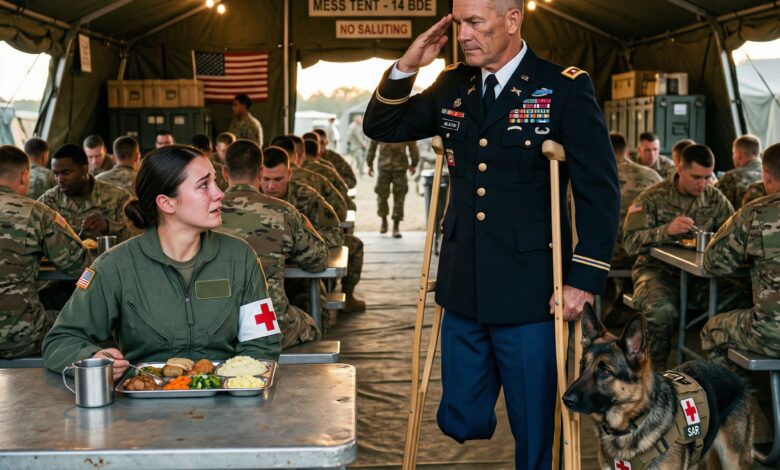
By the time Lieutenant General Marcus Vance approached my table in the mess hall of Fort Resolute and asked if he could sit, I had already spent forty-two days meticulously documenting the ways in which the base was vulnerable. To the world, I was Petty Officer Second Class Avery Nolan, a Navy corpsman on a rotational assignment. I was a medic—a small, quiet gear in a massive military machine that relied on the comforting illusions of rank and routine. Most people underestimated me on sight, seeing only an E-5 with a clean file and a habit of eating breakfast in the same far corner at exactly 06:20. They didn’t realize that I chose that seat because it offered a panoramic view of the room’s rhythm. I learned the pulse of the base through its glitches: which doors lagged, which delivery trucks arrived at irregular hours, and which silences carried the weight of preparation rather than peace.
On that particular morning in March 2026, the atmosphere in the mess hall felt fundamentally fractured. While close to two hundred personnel clattered their stainless steel trays and scraped their forks, the air held a faint, vibrating tension. It was the kind of atmospheric pressure that precedes a storm, unnoticed by those focused on their schedules but screaming to those trained to watch. The first confirmation came from Ranger, a Belgian Malinois attached to base security. Usually a paragon of calm, Ranger suddenly stood, his hackles rising into a rigid ridge along his spine. He wasn’t looking at a person; he was staring fixedly at the food service corridor. When General Vance entered with his aides, the general saw a full room and moved toward my solitary table.
As he began to sit, I didn’t offer a polite greeting. I spoke with a clarity that bypassed the hierarchy of our uniforms. “Sir, you need to leave,” I said. His aides bristled, their hands moving instinctively toward their sides, but Ranger emitted a low, guttural warning that wasn’t directed at me. I pointed toward the serving line where the rhythm of the kitchen staff had broken—one contractor was moving with frantic haste while another had stopped entirely. I repeated my command, louder this time, urging the general to clear the hall without inducing panic. Vance, a man who had reached three stars by knowing when to trust a subordinate’s eyes, didn’t argue. He signaled his aides, and within five minutes, two hundred people were redirected out of the hall before fear could manifest as chaos.
Once the room was empty, I pulled an unofficial neurotoxic field test strip from my kit—a piece of gear I wasn’t technically authorized to carry—and dipped it into a bowl of abandoned broth. The strip darkened to a deep, bruised blue in three seconds. It was a neurotoxic contaminant, calculated not for immediate lethality, but to induce a neurological softening that would effectively shut down the base’s response capabilities for eight to twelve hours. As the official story began to form—a “precautionary evacuation” for a “possible contamination”—General Vance led me into a secure briefing room. He didn’t waste time on protocols or my unauthorized testing equipment. He looked at me and asked a single, pointed question: “How long have you been watching this base?”
I laid my trauma procedures binder on the table, revealing the hidden notebook within. For six weeks, I had tracked the anomalies surrounding Building 7, an ugly, nondescript utility structure that most people stopped seeing after their first day. I had logged unrecorded contractor access, vehicle patterns that defied supply schedules, and the frequent midnight visits of Colonel Stephen Danner, a highly decorated operations planner. I explained that the poisoning of the food was merely a diversion; Building 7 was currently mirroring JSOC-linked planning data during a systems transition. If the command structure had been incapacitated at breakfast, those drives could have been stolen cleanly before noon. My interest in Danner was personal; he had been a contemporary of my father, Chief Ray Nolan, who had died fifteen years earlier in a mission compromise that the history books called “bad luck.”
As I finished my explanation, gunfire erupted from the east service lane. It was a calculated diversion aimed at the perimeter’s weakest point. From the operations overlook, I saw the true shape of the betrayal: an SUV was already peeling away from the rear of Building 7, protected by a sniper positioned on a maintenance roof nearly nine hundred meters away. The shooter was pinning down the remaining response teams, creating a clear exit corridor for the stolen data. In that moment, General Vance handed me a sealed letter with my father’s handwriting on the front—a letter meant to be opened only if saving lives required me to break my mother’s promise that I would never carry a rifle again. I didn’t need to read it to know what it said. I took the Barrett M82 from the rack, felt the heavy kick of the rifle into my shoulder, and silenced the rooftop shooter with a single, technical shot.
We reached Building 7 amidst a storm of dust and shell casings. While the tactical teams surged forward, I reverted to my role as a medic, applying tourniquets and managing airways for the wounded. Danner almost escaped through the lower motor pool, but Ranger found him first, blocking his path with a silent, terrifying rigidity. When I caught up to them, my med kit hanging from one arm and the rifle slung across my back, Danner looked at me and smiled a thin, cynical smile. “Ray would hate this,” he said, invoking my father’s name like a weapon. He claimed my father died because he couldn’t “adapt,” a euphemism for the same greed that had led Danner to sell out Fort Resolute. He raised his sidearm, but Ranger moved first, providing the distraction needed for the arrest team to slam the traitor into the pavement.
The recovery of the drives provided the final, ugly truth. Nested within the encrypted files were logs from fifteen years ago, proving that my father’s final deployment had been sabotaged through rerouted support and withheld alerts. Danner had begun his career of betrayal as a junior planner, and he had spent the intervening years scaling his greed until he was senior enough to orchestrate the fall of an entire base. The institutional fallout was characteristically quiet—Danner disappeared into federal custody, and the official reports spoke of “internal vigilance” while omitting the medic in scrubs and the dog who had seen the lie for what it was.
Six months later, the lessons of that morning have been integrated into the foundation of Fort Resolute. General Vance established a new training initiative for combat medicine, where I now teach corpsmen to think tactically—to not only stop the bleeding but to observe the patterns that lead to the wound. Ranger often visits the course, ignoring the trainees to sit quietly at my feet. I finally opened my father’s letter, which reminded me that the hands that carry gauze and the hands that carry a rifle must both remain steady when the world tries to hide behind the mask of normalcy. I have accepted that my duty is not defined by my rank, but by my willingness to pay attention when everyone else is content to swallow the routine.