50 Men Stormed an Elderly Womans Farm, They Had No Idea Who They Were Threatening!
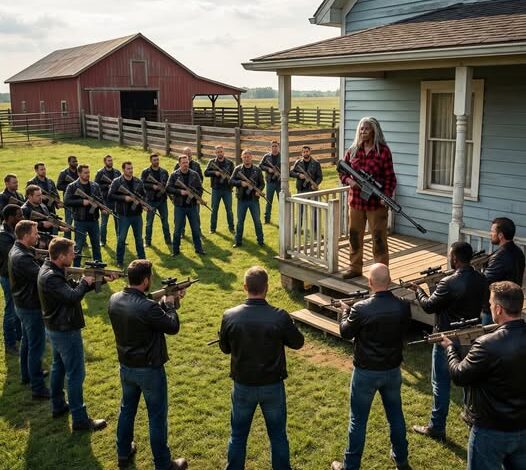
At exactly 6:12 on a heavy August morning, before the heat had fully settled over the land, Evelyn Carter was already walking the north fence line, inspecting the irrigation trench that fed her soybean rows. She moved with patience, not fragility—every step deliberate, shaped by decades of understanding that rushing rarely ends well when you have something worth protecting.
Her farm stretched across one hundred and eighteen acres on the outskirts of Pike County, Georgia. It wasn’t just land. It was history. Generations had worked that soil long before highways reached that part of the state. The farmhouse stood weathered but strong, the barn older still, every beam holding stories no outsider could ever truly grasp.
People in the county saw Evelyn as a quiet widow who handled her own repairs, sold produce on weekends, and kept mostly to herself. They respected her independence, but they underestimated her. What no one talked about—what she never offered freely—was that long before she had become “just a farmer,” she had spent years in military reconnaissance, learning how to read people, anticipate moves, and survive situations most wouldn’t walk away from.
That morning felt ordinary.
Until it wasn’t.
The first SUVs rolled in just after noon.
Three at first, black and polished, kicking up dust along the narrow road. Then more followed, five, then ten, until the entrance to her property looked like a convoy cutting through the heat. Doors opened in unison. Men stepped out—boots heavy, movements coordinated, eyes scanning.
This wasn’t construction.
This wasn’t inspection.
This was something else entirely.
At the center of it stood Wade Mercer.
He wore expensive sunglasses and a confident smile, the kind of man who believed authority was something you projected, not earned. He walked toward Evelyn holding a thick stack of papers, his tone smooth and rehearsed.
“Mrs. Carter,” he said, handing them over. “The state has authorized an emergency land seizure tied to a regional water rights development. This property is now under reassessment.”
He spoke like someone used to winning arguments before they started.
Evelyn didn’t respond right away. She flipped through the pages once, slow and methodical.
Then she looked up.
“These documents are fake.”
Mercer’s smile didn’t falter.
“That won’t matter by tonight,” he replied.
Behind him, his men began spreading across the property.
One kicked over a feed barrel. Another smashed a greenhouse panel. Two more cut irrigation lines like they were clearing obstacles instead of destroying someone’s livelihood.
Evelyn stepped forward, her voice calm but firm.
“You need to leave.”
Mercer moved closer, lowering his voice just enough to make it personal.
“You have until sunset,” he said. “After that, you’ll be removed for trespassing on land that doesn’t belong to you anymore.”
Then, without hesitation, one of his men raised a rifle and shot one of her goats.
The sound cracked through the air, sharp and final.
For a moment, everything went still.
Evelyn walked over, knelt beside the animal, and placed her hand gently against its neck. She didn’t cry. She didn’t react the way they expected.
She stood up.
And something shifted.
They saw it too, though they didn’t understand it.
They thought they had broken her.
They hadn’t.
They had just made it personal.
Inside the house, Evelyn locked the door and moved quickly. She pulled a metal strongbox from beneath an old cedar chest and opened it with steady hands. Inside were three things she had prepared long before that day ever came.
A satellite phone.
A weatherproof drive filled with scanned land records.
And a worn notebook filled with names.
Names that didn’t belong in a rural county dispute.
Names that reached further than Mercer realized.
She climbed to the attic window and looked out across her land. Nearly fifty men now moved across her fields, confident, careless, convinced they had already won.
They didn’t know she had been waiting for a mistake like this.
And they didn’t know how much evidence they had already left behind.
By nightfall, the damage was obvious.
Burn marks cut through her crops. Tire tracks scarred the fields. A broken trail camera lay near the gate—but not before uploading images of several faces. One of Mercer’s men had dropped a container filled with access fobs. Another had used his personal phone within range of an old signal monitor Evelyn had installed years ago.
They weren’t just trespassing.
They were exposing themselves.
Evelyn didn’t chase them.
She documented them.
She called Sheriff Tom Bledsoe using the satellite phone. When she said “forged seizure,” he didn’t interrupt. He told her deputies were delayed, tied up elsewhere. She told him that delay might cost everything.
Then she called someone else.
Calvin Reese.
Sixteen years old, sharp, reliable, and familiar with her land. She instructed him to retrieve backup deed records hidden in a grain bin and take them straight to town.
He agreed.
Then he did what brave people often do.
He came back anyway.
As night deepened, Mercer’s men grew careless. Floodlights flickered on the east side. The tractor engine roared unexpectedly, drawing attention away from the house. Shadows shifted.
And Mercer started talking.
He spoke about drilling rights. About permits. About a pipeline route hidden beneath her land. About officials who wanted this finished quietly.
This had never been about water alone.
It was about control.
It was about profit.
It was about eliminating the one person who refused to sell.
At 9:20 p.m., Calvin arrived with more than documents.
He had footage.
Security video showing Mercer meeting with county officials, exchanging envelopes and maps days earlier.
Proof.
Real proof.
Minutes later, Mercer’s men spotted movement.
They caught Calvin.
Dragged him into the yard.
Mercer called out into the darkness.
“Bring me the records,” he shouted. “And the boy walks.”
Evelyn stepped into the light.
Empty-handed.
Mercer smiled.
He thought she was surrendering.
He didn’t realize everything that mattered had already been sent.
When Sheriff Bledsoe called back, his voice was different.
State investigators were on the way.
Warrants issued.
The operation exposed.
Mercer’s composure cracked.
He gave new orders.
Burn the house.
Search everything.
Destroy the evidence.
Flames climbed the porch within minutes, licking at curtains, consuming decades of history.
Evelyn watched it burn.
She didn’t move.
Not because she didn’t care.
But because she knew something Mercer didn’t.
The most important evidence wasn’t inside.
It was already safe.
Hidden.
Copied.
Distributed.
By the time authorities arrived, Mercer’s convoy was already trying to leave.
They didn’t make it far.
Roads blocked.
Vehicles stopped.
Men arrested.
Excuses thrown out like lifelines.
Inside their vehicles, officers found everything—fake documents, stolen seals, cash, maps, burner phones.
The truth wasn’t buried anymore.
It was exposed.
Mercer went down hard.
Charges stacked—fraud, arson, conspiracy, racketeering.
And he didn’t fall alone.
Investigations spread beyond Pike County.
Officials resigned.
Deals unraveled.
Questions surfaced that no one wanted to answer publicly.
The farmhouse was gone.
Reduced to ash and memory.
But the land remained.
Months later, a new structure stood where the old one had been. Smaller, stronger. The fields grew again. The fences were rebuilt. Life returned, not the same, but steady.
A sign appeared at the gate.
CARTER FARM — STILL HERE.
Evelyn never chased attention.
When asked what happened, she said only what mattered.
“This wasn’t about one person defending land,” she said. “It was about what happens when people think no one will push back.”
And though justice had been served on paper, one detail lingered.
A line found in Mercer’s notes.
Three names blacked out.
Followed by a single sentence.
Phase Two approved if Carter removed.
No one ever explained who wrote it.
Evelyn didn’t need them to.
She understood something most people never do.
The men who show up are rarely the ones who start it.
And the ones behind them don’t always get caught.